What this test revealed is the more recoil reduction the louder the Brake is for the shooter.
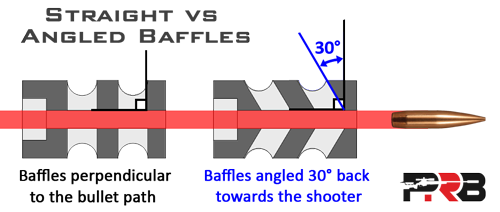
One thing interesting to note, that isn't apparent in the photos, is that the top 5 performers all have angled baffles (i.e. the baffles aren't perpendicular to the bullet path).

Here is a breakdown of how much the top muzzle brakes are angled back toward the shooter (0° indicates the baffles are perpendicular to the bullet path). There seems to be a strong correlation between the angle and overall rank.
- Alamo Four Star Cowl Induction Brake = 35°
- American Precision Arms Fat B* = 30°
- American Precision Arms Little B* = 30°
- JEC Recoil Reduction Brake = 15°
- Holland Radial Quick Discharge Brake = 15°
- Center Shot Rifles Blast Tamer = 0°
- JP Recoil Eliminator = 0°
- Impact Precision Muzzle Brake = 0°
- JP Large Compensator = 0°
- West Texas Ordnance Muzzle Brake = 0°
I believe there are only 2 outside the top 5 that have angled baffles, the tiny
TBAC Compact Brake and the smaller version of the
Holland Radial Quick Discharge Muzzle Brake. The angle definitely isn't the only thing that plays into recoil performance, but it's clearly significant.
However, in the section on muzzle devices from
Dr. Carlucci's textbook, Ballistics: Theory and Design of Guns and Ammunition, he reminds us
"Best design practice is to divert gases to the sides of the weapon, because rearward diversion could affect an exposed gun crew." During my tests, a manufacturer sent me a prototype of a muzzle brake with 45° baffles back toward the shooter. It provided outstanding recoil reduction (better than anything shown here), but while testing that brake, a friend helping me with the tests caught some shrapnel in his side. It penetrated 2 shirts and caused a wound deep enough to see flesh. I told the manufacturer I wouldn't write about it, because I didn't think it was safe. They were concerned as well, and haven't release that prototype for sale.
The other downside of angled port designs is increased concussion/blast. All of the muzzle brakes are loud, but diverting gases rearward can increase the pressure shock wave at or near the shooter's position. Some shooters would rather deal with the extra recoil than the increased concussion from that shock wave. So that is another thing to keep in mind. The sound test should give us insight into the pressure difference at the shooter's position for each brake, so stay tuned for that.
There are clearly downsides to rearward deflection of gases, but it also has a measurable influence on recoil reduction. I don't want to present this as "right or wrong."
There seems to be a correlation between how loud a brake is, and how well it reduces recoil. Most "quieter" brakes aren't good at reducing recoil, and most of the brakes that are great at reducing recoil are very loud.
Like the other tests, I assigned a rating to each of the brakes in terms of how loud they were. My rating system worked like this: If a brake was only 20% louder than a bare muzzle, it would receive a full 10 rating. If a brake was 150% louder than the bare muzzle (which would be 2.5 times as loud), it would receive a rating of 0. The ratings were based on the measurements we made from behind the rifle.
Here are the loudness ratings, and I included the recoil results.