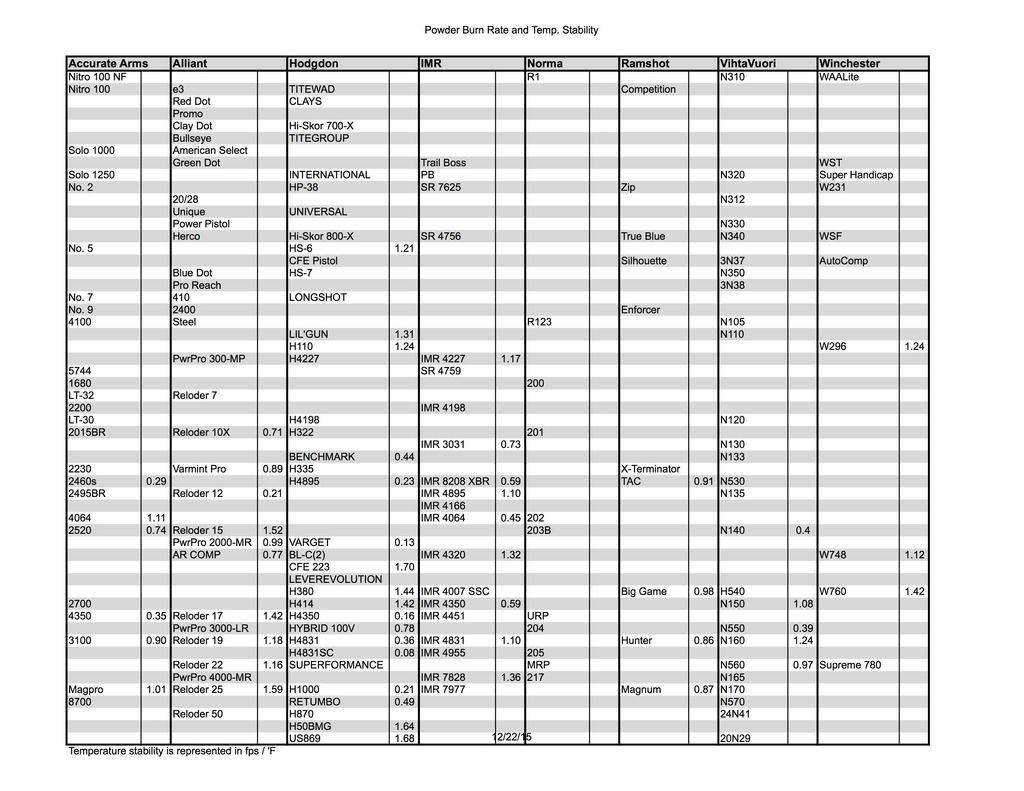
Temp stability chart

cohunt

Well-Known Member
Joined
Jan 21, 2016
Messages
6,415
Reaction score
11,350
City & State/Province
Colorado Springs, CO
Anyone have a link or post a pic of a reliable temp stability chart? Mainly looking for varget, reloder 16 and 23, h1000, retumbo but others would be nice too

I've seen a few charts but the numbers don't seem to be very consistent from chart to chart---- would that be related to cartridge tested and lot number tested possibly? How about a nice average ?
 
Last edited:
Temp Stable.jpeg
 
I have the same chart. Not sure if its origin. What I can say is that Varget, H1000, and H4350 are very temp stable, because we've tested them.

My son actually did a High Skrool science experiment entitled "The Effect of Temperature On The Burning Rate Of Propellants".

We tested over a couple of 60 degree days. 1 lot sat out (in the shade) at ambient temp (60°), 1 lot was in a baggie in ice water for 2 hours (32°) and 1 lot was in my pocket with 2 chemical hand warmers for 2 hours (100°).

The Hodgdon Extreme Line Propellants we tested were very temp stable, similar to the numbers on that chart. The ADI (Australian Defense Industries) Surplus 7.62 NATO ammo we used as a control was something wild like 1.5 or 2.0 fps per degree.
 
I've heard they are close to varget .13 fps/degree
According to one chart I have seen it stated that Rl 16 is .34 fps/degree but I have never seen figures for Rl 23 or Rl 26.

I do wonder how accurate these charts are as I have seen Rl 22 listed at 1.21 fps/degree on one chart and 1.71 fps/degree on another. That is a 41% increase.
 
ADI produces the Hodgdon line of powders, therefore, finding the information you seek regarding those powders is available through ADI.
Having worked there personally, almost all of their single base powders utilise the temp stable technology. It is part of their make-up, the only powder I am unsure of is H50BMG (AR2218) as called by ADI.
Although I use this powder, I have no knowledge if it is one of the Extreme line officially, but I see no temp instability using it in my loads that run 125g+.

Cheers.
 
Temp stability is not just dependant on the type of powder. "Temp stability" or maybe better described as velocity variation relative to temperature. The reason I would describe it this way is because extreme cold and hot conditions changes the bore diameter as well as bullet diameter as well as case dimensions. . It also changes the metal properties of both the bullet and the barrel. Another factor is what cartridge the power is loaded in and what pressures the powder sees in the burn cycle. The same powder will burn at a different rate in different cartridges with different bore diameters and bullets weights. Also powder burns differently at different temperature. It's very hard to say per degree because velocity change is not linear to temp change.
So to concluded. This number we all want to look at a chart for, is simply not available. Even if it was it won't be accurate. The only possible way to test this, is to test it yourself in every gun you own. To do this properly will cost a pile of money and time. So.. I generally just check my velocity at either end of what I think I'll shoot my rifle in and average the number per degree and it gets me a close number. Not perfect, but closer than not accounting for it. I also just use common powder that are extremely stable. Varget h4350 h1000 4831sc Vv140 things like that.
 
ADI produces the Hodgdon line of powders, therefore, finding the information you seek regarding those powders is available through ADI.
Having worked there personally, almost all of their single base powders utilise the temp stable technology. It is part of their make-up, the only powder I am unsure of is H50BMG (AR2218) as called by ADI.
Although I use this powder, I have no knowledge if it is one of the Extreme line officially, but I see no temp instability using it in my loads that run 125g+.

Cheers.
It says on the label (and Hodgdon's website) that H50BMG is part of the Extreme Line.
Probably a big part of the reason it's very popular with the ELR crowd.
 
Temp stability is not just dependant on the type of powder. "Temp stability" or maybe better described as velocity variation relative to temperature. The reason I would describe it this way is because extreme cold and hot conditions changes the bore diameter as well as bullet diameter as well as case dimensions. . It also changes the metal properties of both the bullet and the barrel. Another factor is what cartridge the power is loaded in and what pressures the powder sees in the burn cycle. The same powder will burn at a different rate in different cartridges with different bore diameters and bullets weights. Also powder burns differently at different temperature. It's very hard to say per degree because velocity change is not linear to temp change.
So to concluded. This number we all want to look at a chart for, is simply not available. Even if it was it won't be accurate. The only possible way to test this, is to test it yourself in every gun you own. To do this properly will cost a pile of money and time. So.. I generally just check my velocity at either end of what I think I'll shoot my rifle in and average the number per degree and it gets me a close number. Not perfect, but closer than not accounting for it. I also just use common powder that are extremely stable. Varget h4350 h1000 4831sc Vv140 things like that.
The same thing can be said for burn rate charts. I would have to see test data to see just how much a 50 or even 80 degree change is going to affect bore diameter, bullet diameter, etc.
 
The same thing can be said for burn rate charts. I would have to see test data to see just how much a 50 or even 80 degree change is going to affect bore diameter, bullet diameter, etc.
I believe Hornady has a podcast regarding this topic as well Applied Ballistics has an article. I'll have to dig to find it.
 

Recent Posts

Back
Top