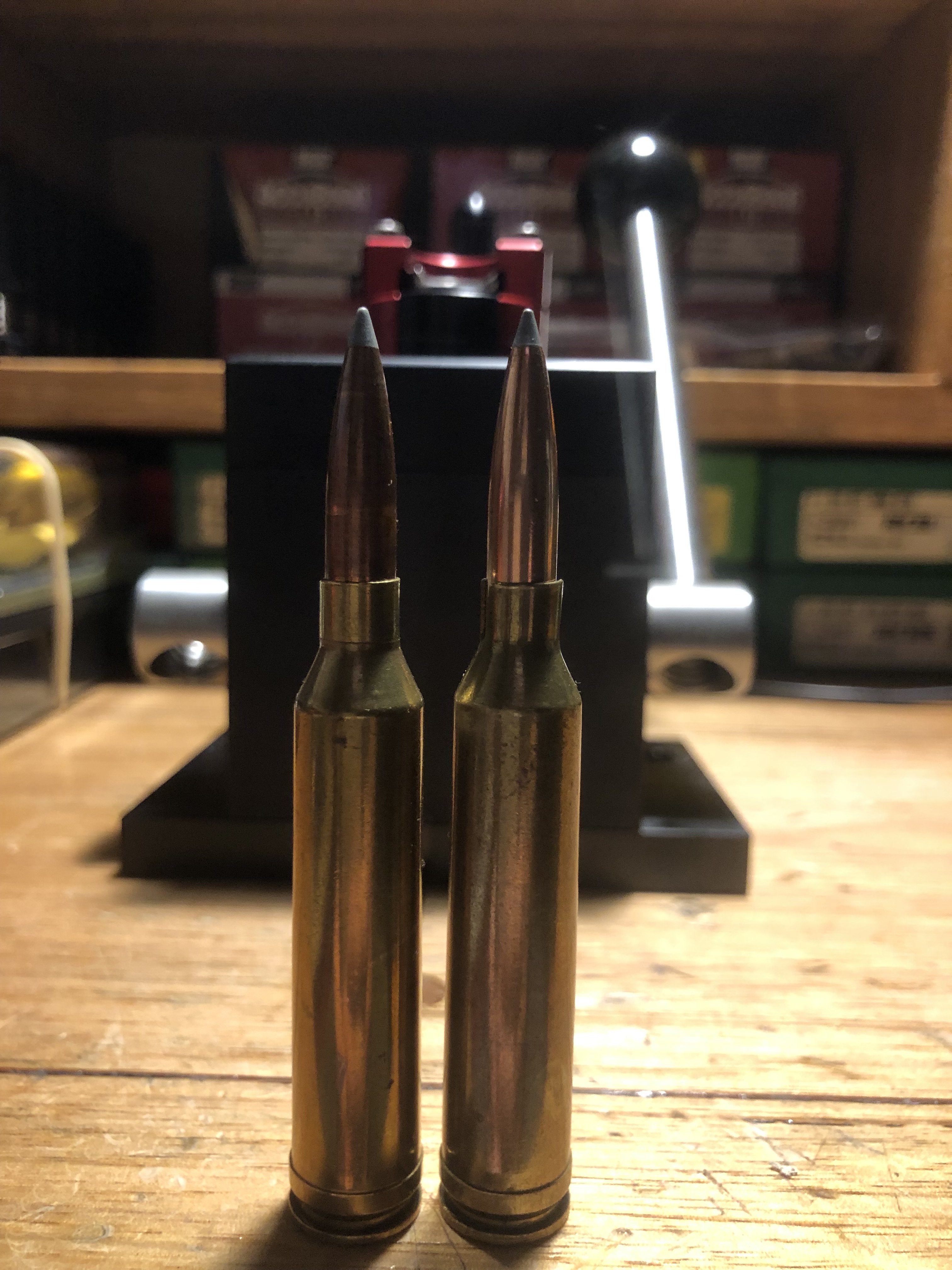
Fire forming brass

Do you fire form your NEW “quality” brass before beginning load development?


  • Total voters
    72

JAYgs8163

Well-Known Member
Joined
Sep 27, 2011
Messages
7,171
Reaction score
11,145
City & State/Province
Southern Arizona
This came up the other day in a thread and I didn't want to derail the OPs thread by going off topic. So, I figured it would be a good topic for discussion and a poll. I like to fire form my brass before I do any serious load development for my rifles. I'm not a competitive shooter and primarily develop loads for hunting, I am however extremely picky about results. I usually will fire form 40-50 pieces of brass using a few different powders, primers, etc and take notes just to give me some direction as to maybe where to focus my load development on. Some questioned my wanting only fire formed brass for the serious load development and that the new unfired brass should perform the same or very close (that's great, but personally I don't hang my hat on new unformed brass as it's a one and done thing and then it's fire formed). Anyways…. I develop my loads only using fire formed brass. "Quality" defined as Lapua, ADG, Peterson, Alpha, and the similar brands I may have missed. Stay on track here all and let's not argue or get into a chest pounding discussion.
 
New brass coincides with a new barrel/build for me, normally. I always fire brass at least once at a reduced pressure to:
A) Form to chamber/Gain capacity
B)Work harden it for higher pressure loads later
C) Ensure consistency with serious load development/remove that variable
D) Season the new barrel, removing that variable as well
* Sometimes it takes more than one firing to fully fit the chamber.
I do think some general seating depth preference can be identified in reduced pressure loads, after maybe 20-30 shots or so to remove anything left by the reamer. Some barrels less and some more, as always. Fine tuning is for later anyhow at normal pressure.

This is my procedure no matter if I'm forming for improved chambers or if the brass is "formed". FWIW.
 
Excluding the formation of Ackley cases, I can get a lot load work completed using virgin cases, such as powder preferences and basic node identification as well as primer preferences and sometimes neck tension narrowed down.
I try not to waist barrel life and not learn something about it.
 
I am divided on the response depending on cartridge, rifle, load and purpose. Anything I load for high precision or AI, I most definitely fire-form first, but there have been some loads in new brass that gave very good precision for the hunting/shooting task intended. Similar to people who purchase or use factory or military match ammo and win competitions. In my younger days, I shot a lot of mil 7.62 match ammo that performed very well, and sometimes, it was a challenge to load those fired cases and make them outperform their original.

Through the decades, there have been several times I purchased 500 or 1,000 new cases for my varmint rifles, and once I found a very precise load for those rifles while using the new brass, I loaded a lot of it for an upcoming, high volume varmint season like pdogs. Once fired, I would retest those loads to see if they still preformed as well after forming, and while some did, others needed only a slight tweaking.

As long as they are meeting my precision and other requirements, many of my "shorter range" hunting loads did not receive an initial fire-forming before usage, but most of those current cartridges have already been shot a few times and thus formed.
 
These were fired in cases being blown from basically 25/280AI up to 25 Sherman LA, both groups at 300yds. Fairly mild pressure of course, but I knew the seating depth already. Touching.
Things can work out sometimes without complicating them. Nicely. This is also a rifle that shoots everything I've tried reasonably tight and some phenomenally snug, with exceptional velocity also. Big Shilen Select #6
 

Attachments

  • IMG_6065.jpeg
    IMG_6065.jpeg
    1.5 MB
  • IMG_6042.jpeg
    IMG_6042.jpeg
    1.6 MB
  • IMG_7518.jpeg
    IMG_7518.jpeg
    1.6 MB
  • IMG_7887.jpeg
    IMG_7887.jpeg
    5.1 MB
Not afraid to do some load development with new brass. Expectation is that I will have to tweak it once all are fireformed. Once I have a lot of say 50-100, I will load up 10 and check velocity/group. If it has slipped, I expect to change it. If this is a new barrel, it will probably need to be tuned a bit with break in and fireforming anyway. But in that first 100 rounds I can learn what it likes and doesn't and potentially how fast it is going to like to shoot. I do not typically try to hot rod it on the first firing though. Depends on the cartridge too. Hard to send 100 RUM rounds down range in only a few outings and expect it to last for a while.
 
I voted yes.
I have always fireformed my brass 3 times with neck sizing only prior to load development, this will never change.
I hunt with new unfired brass when using a new batch. All the testing was done previously in the same batch.
I measure volume prior to starting ANY testing.
I do seating depth testing first, then primer testing second, and powder testing last. Neck interference testing is done at the same time I test seating depth.
This gives me ample fully fireformed cases to do full powder load development. These cases are used to determine shoulder bump first before load development starts.
Brass takes several firings to become stable, inside of 3 firings the brass expands at different rates, this is not precise enough to do load development with, IMHO.

Cheers.
 
The specific reamer used compared to the actual brass dimensions would definitely affect the measurable brass growth, potential changes etc.
I'm sure Magnum Maniac could elaborate on this.

Some brass companies seem to enjoy the practice of tweaking their product to keep us guessing.
 
I have a new build 6.5 GAP and 200 new ADG brass. My plan is to find a decent lower node, with seating depth and run them like I'm buying boxed ammo ready to go. It's a test on whether it will act like good boxed ammo and give me acceptable accuracy for 1000 yards or less while forming my brass. It's a target rifle just for long range plinking, trigger time at distance, nothing more. I don't want to run multiple tests on 200 pieces of brass only to burn the barrel out early. We shall see if this approach works.
 
I never worry about fire forming all brass before I finish load development.

I've read that you have to shoot twice to be fully fire formed. That's a lot of shots for a 100 lot bag of brass.
This is why you load in batches of 50-100 anyway. Getting a new barrel run in takes 150-200 firings…
The specific reamer used compared to the actual brass dimensions would definitely affect the measurable brass growth, potential changes etc
Brass from new never expands at the same rate across all in the bag.
Thinnest side expands first, then it either moves into the shoulder and neck, or it thins even more creating uneven movement.
Sizing will cause this brass to be different than brass that hasn't thinned, dimensions internally will be different.
I never size to the neck/shoulder juncture for this reason, brass movement there is critical, so I leave it alone.
Here's a photo of what I am talking about, zoom in and you will see why my precision loads are not sized here, the pressure ring doesn't exist, yet, I never seat bullet shanks below this point. This is my custom chambered 264WM, it prints into 1/4MoA 99% of the time.

Cheers.
 

Attachments

  • IMG_2701.jpeg
    IMG_2701.jpeg
    1.4 MB
Back
Top